
OvenLabs is a technology startup specializing in Mathematical Model Based Simulations to support informed, data-driven decision processes. We partner with organizations that understand the necessity of precise financial planning but seek to move beyond the inherent limitations of traditional budgeting methods.
The Evolution of Financial Forecasting
For organizations relying on budgeting, the goal is to define future financial needs while mitigating risk. We observe three distinct levels of maturity in defining project costs and operational expenses:
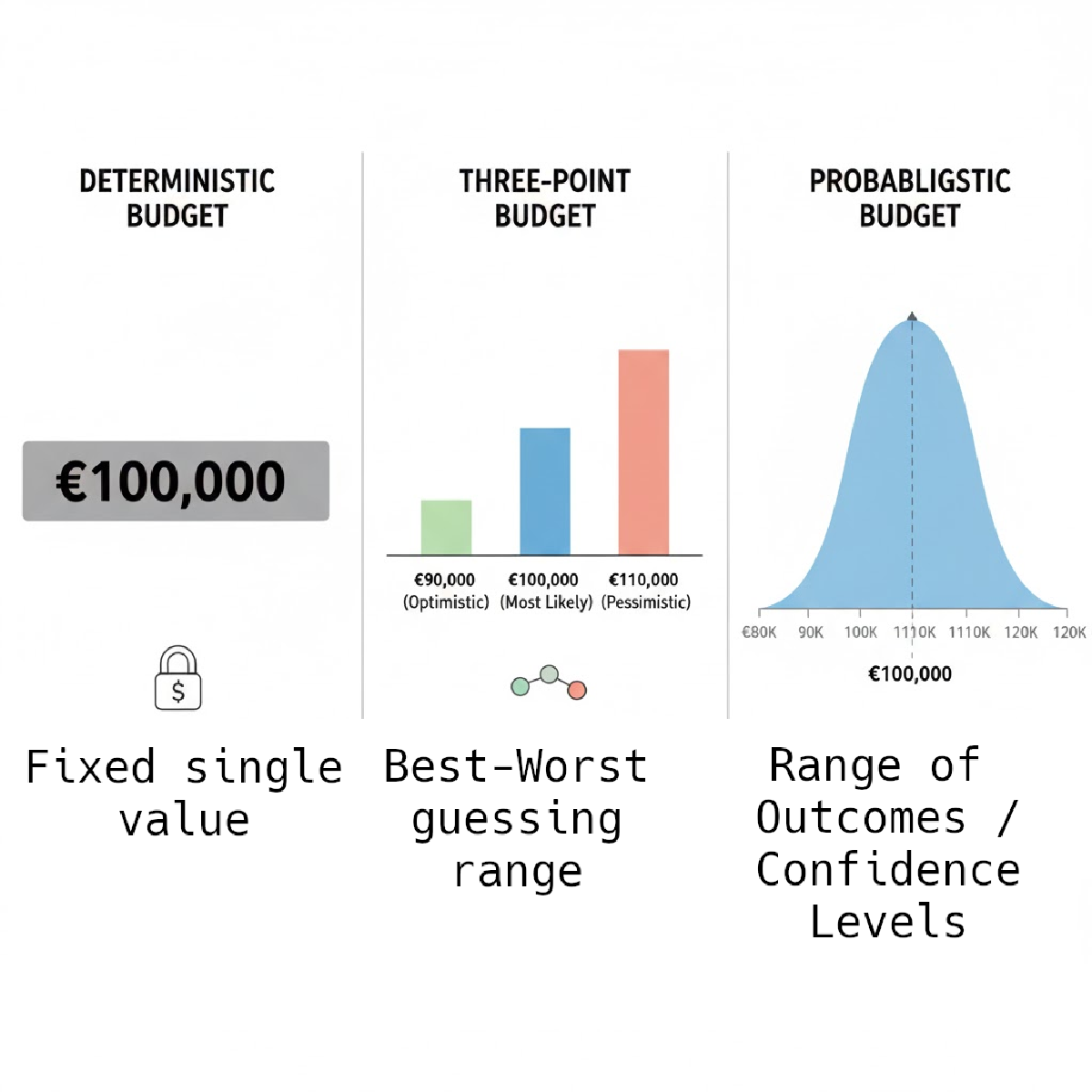
1. Regular Budgeting (Deterministic)
The standard approach uses a single-point estimate for each cost item. This “regular budget” relies on historical records or simple projections to define one expected monetary value.
- Limitation: This method provides an illusion of certainty, but it inherently ignores all risks and uncertainties, offering no indication of the likelihood of success or failure. Strategic planning based on this method often relies on intuition or assumptions.
2. Three-Point Budgeting (Bounded Uncertainty)
A more advanced method acknowledges uncertainty by providing three fixed values for each cost item:
-
Optimistic (O): The lowest potential cost.
-
Pessimistic (P): The highest potential cost.
-
Expected (E): The most likely cost.
-
Limitation: While it establishes boundaries of uncertainty, the three-point budget still uses discrete, static numbers. It fails to quantify the probability of any specific outcome occurring between the optimistic and pessimistic extremes, leaving decision-makers unable to prioritize financial strategies effectively.
3. Probabilistic Budgeting (Quantified Certainty)
Probabilistic Budgeting utilizes the principles of probability and Statistical and simulation models to analyze project costs. This methodology moves beyond static numbers to quantify the full spectrum of possible financial results.
At its core, “probabilistic” means transforming uncertainty into a quantifiable distribution of outcomes. By feeding comprehensive data into a probabilistic analysis engine, such as the Project Costs and Risks Simulation Engine within the Faina platform, we generate:
- A Range of Results: Not just one number, but thousands of simulated scenarios that capture the interdependence of various risks.
- Confidence Levels: The output defines the probability associated with achieving specific budget goals (e.g., “There is an 80% chance the final cost will be below $1.2 million”).
This rigorous approach ensures planning is based on science and advanced analysis.
Why Probabilistic Budgeting is a Win Differentiator
OvenLabs is on a mission to help companies make better decisions based on Mathematical Models. Implementing Probabilistic Budgeting via our proprietary web platform, Faina, provides a definitive competitive advantage by simplifying complex analysis and delivering clarity where conventional tools fail.
1. Anticipate Financial Impacts and Mitigate Risk
The reliance on intuition and spreadsheets often leads to project budgets being surpassed, as studies indicate. Probabilistic Budgeting provides the capability to anticipate cost overruns, evaluate alternative scenarios, and simulate financial impacts before they occur. This capability transforms financial management from a reactive exercise into a proactive, strategic function, turning uncertainty into an actionable advantage.
2. Accessible Sophistication
Historically, advanced simulation and probabilistic risk analysis were restricted to expensive enterprise solutions requiring highly specialized users. OvenLabs eliminates this barrier.
Faina is a web-based platform designed to democratize access to these tools. Our differentiation lies in providing accessible sophistication:
- Ready-to-Use Models: Faina is packed with preconfigured models for diverse industries, including the Probabilistic Budget model. These models are ready to use upon importing data, eliminating the complex development stage required by competing tools.
- Intuitive Interface: The platform features an intuitive user interface with a gentle learning curve, allowing any user to harness advanced analytics without needing to be an expert in data science.
3. Optimized Decision-Making
By providing clear, sophisticated visualization tools that convert complex data into clear, actionable insights, OvenLabs empowers decision-makers to prioritize actions and optimize resources. This capability ensures that capital is allocated based on the probability of risks and opportunities, not merely on a guessed-at single-point estimate.