Or how to adopt AI in an SMB without throwing away money (or your sanity)
This is a short, practical guide to strategic implementation for SMBs in Latin America and Argentina.
We will follow a fictitious SMB on its potential journey toward AI implementation.
Let’s meet Daniela and Raúl, who started a t-shirt company: Impresiones Para Vestir (Prints to Wear). They buy blank t-shirts from a supplier and print beautiful designs on them.
They have set up a shipping system as well as a discount and promotional program.

Recently, they heard that companies without AI will struggle to compete, so they decided to find a way to incorporate it into their operations.
What did Daniela and Raúl hear?
Artificial Intelligence will deliver unlimited efficiency, drastic cost reductions, and immediate operational transformations. Whoever doesn’t ride the wave will drown in a sea of uncertainty.
About what Daniela and Raúl heard
The phenomenon of generative Artificial Intelligence burst onto the corporate agenda with promises like the ones mentioned above. However, after the initial wave of technical fascination, most SMBs find themselves at a pragmatic crossroads: how do we transition from the recreational or experimental use of chatbots to generating measurable value on the bottom line?
In the regional economic context, marked by capital constraints and volatility, technology adoption cannot respond to fleeting trends. It requires a surgical, process-oriented approach that is deeply conscious of operational reality.
So, Daniela and Raúl prepare to review this guide to find the best way to implement AI in Impresiones Para Vestir.
1. Rule Zero: If you automate chaos, you get automated chaos
Daniela and Raúl discover that one of the most frequent mistakes in digitization and AI implementation processes is assuming technology will fix operational design inefficiencies.
Delving a bit deeper into the subject, they find that Artificial Intelligence is not a corrector of flawed processes; it is a speed and scale amplifier. If a workflow lacks standardization, clear responsibilities, or defined quality criteria, introducing AI will only accelerate the production of errors and disorganization.
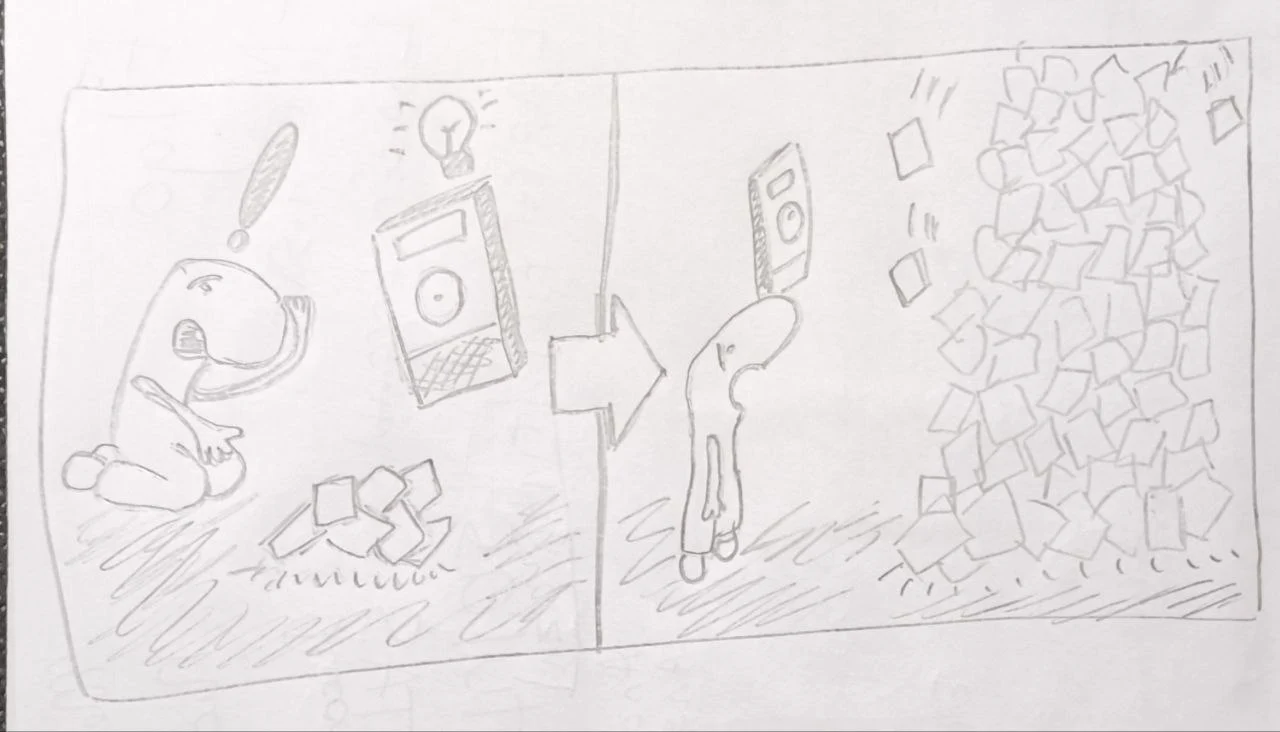
Therefore, they decide that before deploying any automated solution, the organization must audit its critical processes:
-
Workflow Mapping: Identify inputs, transformations, and outputs of information in each area.
-
Prior Standardization: Ensure that repetitive tasks follow a Standard Operating Procedure (SOP).
-
Data Cleaning: Guarantee that input data is consistent, structured, and accurate.
Impresiones Para Vestir
Daniela and Raúl find an interesting workflow to work on: email and social media inquiries, which range from someone wanting to buy a single t-shirt to resellers requesting large wholesale quantities.
They set out to map this workflow, creating a procedure to follow, understand, and measure it.
In doing so, they find that this workflow queries their stock database, which is a bit messy. So they decide to consolidate the entire database into a single tool.
2. The Hammer Syndrome and the “Flip-Flop Big Data” Trap
In their search, the founders of Impresiones Para Vestir discover that among companies looking to implement AI, there is a tendency to look for applications for AI before defining the business problems they are trying to solve.
This phenomenon, known as “hammer syndrome” (where every problem looks like a nail), leads to unnecessary investments and organizational frustration.
Added to this is the illusion of Big Data: the idea that a company needs to process massive volumes of unstructured data to gain value. In the SMB segment, as is the case for Impresiones Para Vestir, value rarely lies in complex analytical models built over gigabytes of noisy data; rather, it lies in structuring small sets of high-quality data (Small Data) that directly impact daily decision-making.
Daniela and Raúl end up building a table classifying potential approaches for their company.
| Not Recommended Approach | Strategic Approach |
|---|---|
| Searching for where to apply AI just because it’s a trend. | Identifying a financial or operational bottleneck beforehand. |
| Trying to analyze massive volumes of heterogeneous data. | Structuring specific customer or inventory data for targeted tasks. |
| Acquiring complex licenses without clear training. | Solving a concrete inefficiency with the simplest available tool. |
Impresiones Para Vestir
Although Impresiones Para Vestir started this journey thinking about AI, it is now clear that they have identified a bottleneck: a real use case that can be improved. The process of reading incoming messages, filtering them, searching the databases, and drafting responses consumes at least two hours a day from the team. They also discover that almost 30% of messages are discarded for various reasons.
3. Security from Day Zero: Don’t hand the house keys to an unknown guest
One truly interesting thing Daniela and Raúl discover is that operational enthusiasm must not overshadow data governance and information security.
What does this mean? When interacting with cloud AI tools, companies frequently expose confidential information, customer data, trade secrets, or intellectual property—often inadvertently.
Daniela finds an enlightening analogy. If you are building your home, and your enthusiasm leads you to lay down pretty rugs, set up furniture, and hang a couple of Paul Klee paintings, but you leave installing a front door for later, security is compromised. Security must be thought through from hour zero. Then, as the house gets